Engineers are used to explaining big things to people who aren’t engineers. A bridge span, a dam spillway, a power turbine, a metro station. The numbers are clear to the team, but the audience wants to see what the thing is and how it works.
A good engineering scale model closes that gap. It shows the structure in a form people can walk around, and when it’s built with a bit of thought, it explains the engineering idea as well as the shape. Let’s look at where these models are used and what makes them effective.
Structures That Are Hard to Picture
Some structures are so large or so unusual that drawings only go so far. A cable-stayed bridge has a pattern of cables, towers and deck that’s hard to understand from a plan. A dam has a body, a spillway, gates, intake towers and a reservoir that all interact. A cooling tower or a bridge pier sits partly underground, partly in water.
A physical model lets people see the whole arrangement at once. They can follow the load path, notice the proportions and ask better questions. The explanation that would take ten minutes with drawings often takes two minutes with a model.
Teaching Engineering Ideas
Colleges and training institutes use models to teach concepts that are tough to grasp on paper. How a truss carries load. How a suspension bridge distributes tension. How a retaining wall resists soil pressure. How a hydraulic gate lifts.
A cutaway model that shows internal reinforcement or a working model that demonstrates movement can make a concept click in seconds. Students remember what they’ve touched. Teachers often say that a good model turns a dull lecture into a real conversation.
Proposals, Bids and Client Presentations
Engineering firms competing for large projects need to stand out. A model of the proposed bridge, tunnel, port or treatment plant tells decision-makers that the team understands the project and can express it clearly.
It also reduces misunderstanding. Clients who see a model can say, “I imagined the approach road coming from the other side,” and the team can adjust before a design goes too far. Proposal models don’t have to be elaborate, but they do need to be accurate and neat.
Public Consultation and Approvals
Infrastructure projects affect communities. People worry about noise, access, safety and visual impact. A model helps officials and residents see what’s planned, where it sits and how it relates to their neighbourhood.
When it’s honest, the model builds trust. Seeing a flyover’s real height beside the nearby homes, or the position of a pumping station relative to a river, tends to calm rumour and invite practical feedback.
Construction Planning and Sequencing
Contractors find engineering models useful for planning. They can think through how to build a bridge span by span, where to place cranes, where the temporary works go and how material moves across the site.
A sectional model can show stages, with parts that can be added or removed to represent each phase of construction. This is a clear way to brief site teams, especially when several contractors work in the same area.
Failure, Load and Safety Demonstrations
Some engineering models are built specifically to show how things behave under stress. A beam that deflects under a small weight. A truss with one member removed. A column that buckles when the load goes up. A retaining wall that tips when water pressure builds.
These demonstrations are valuable in teaching and in client discussions about safety. They make abstract ideas physical. They also need to be built honestly, using materials and proportions that behave in a believable way, because a misleading demonstration is worse than none.
Rail, Metro and Transport Projects
Transport infrastructure is full of structures that are hard to explain: elevated viaducts, underground stations, interchanges, depots, signalling systems and station plazas. Models of these projects help planners, politicians and passengers understand how the system fits into the city.
Sectional models are especially useful for stations, with cut-away floors that show platforms, concourses, escalators and entry points. A well-made station model can answer in five minutes the questions that would otherwise fill a whole meeting.
Water, Irrigation and Environmental Works
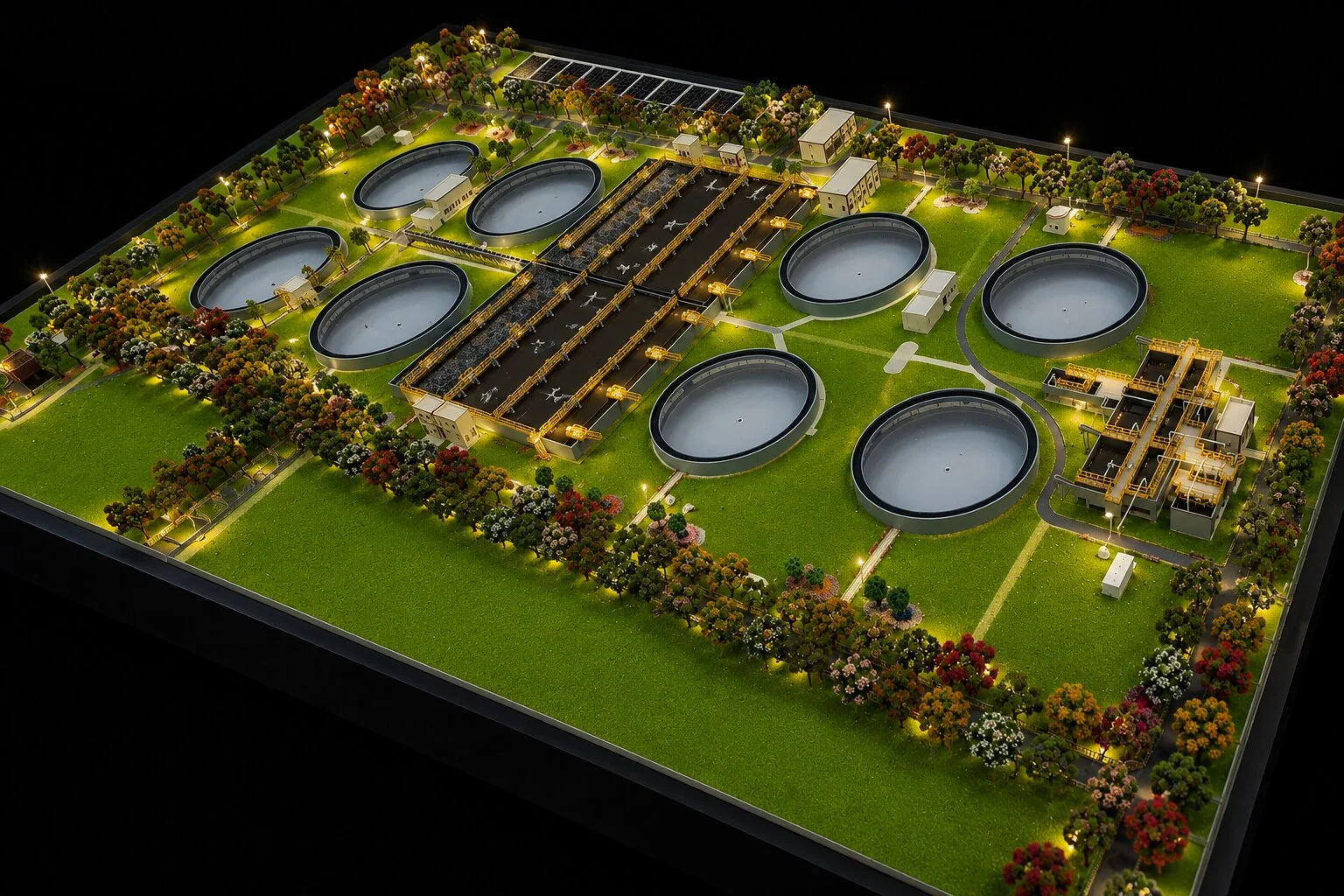
Water projects such as canals, barrages, pumping stations and treatment plants often involve complex flows. A model can show how water enters, moves through the system and leaves. Blue lighting or clear resin channels suggest flow without needing real water.
Environmental engineers use models to show flood protection, drainage systems and river training works. Communities that live near such works often feel more comfortable when they can see how a scheme operates and where its edges lie.
What to Show, and What to Leave Out
A model can’t show everything, so the maker and engineer need to agree on the story. Is it about overall form? Structural system? Construction sequence? Surroundings and impact?
Once the focus is clear, the details follow. A structural model might expose reinforcement or steel frames. An overview model might show only the outer form with accurate surroundings. Trying to show everything usually results in a model that’s busy and confusing.
Accuracy and Tolerances
Engineering audiences are sharp-eyed. They’ll notice if a pier is in the wrong place or a span is out of proportion. Models for this field need careful measurement and verification against drawings.
Good makers work from dimensioned drawings, check key measurements during construction and invite the engineer to review at stages. They also explain where the model has been simplified, so nobody mistakes it for a precise replica.
Showing the Construction Process
Phased models are a good way to show how a major structure will be built. A bridge model might come apart to show foundations, piers, girders and deck in sequence. A tunnel model might show excavation stages and lining.
Site teams like these because they can brief contractors and discuss risks without piles of drawings. Funders like them because they understand the project timeline and see where the milestones lie.
Scale and Material Choices
Large infrastructure uses small scales. A bridge might be modelled at 1:100 to 1:500, a dam at 1:200 to 1:1000. Details such as cables, gates and railings are scaled carefully, and some are slightly thickened so they stay visible and sturdy.
Materials depend on the purpose. Clear acrylic helps show internal parts. Metal rods suit cables and bracing. Resin and printed parts form complex shapes. Wood or board gives a warm, classic look for display. The right choice depends on how the model will be handled and viewed.
Terrain, Water and Setting
Engineering works are tied to land and water. A dam sits in a valley. A bridge crosses a river. A tunnel enters a hillside. The base should reflect these conditions with contour layers, water surfaces and vegetation.
Water is typically modelled with clear resin or layered acrylic over a painted base, giving depth and gentle reflection. Rock, soil and vegetation textures complete the setting, so viewers can understand how the structure responds to the site.
Working Features and Demonstrations
Some models include moving or lit parts. Gates that open, water that flows, lights that trace a path, a train that crosses a bridge. These features make a model memorable, particularly at exhibitions and science centres.
They also add complexity. Motors, wiring and mechanisms need planning and maintenance access. Ask the maker how they’ll keep the features reliable, and consider including only the ones that serve your message.
Cost and Planning Tips
Engineering models take longer than they look, because accuracy checks and iteration add time. Agree on key milestones, such as drawing review, base and structure approval, detail stage and final finishing. Leave room for engineer review at each stage.
Cost depends on size, accuracy, materials, moving features and lighting. If budget is tight, ask the maker which parts to simplify. Often the structure itself can be built cleanly while the surroundings stay modest.
Briefing the Maker
Provide dimensioned drawings, 3D data if available, site plans and any reference photos. Explain the purpose, audience and display location. List the features that need to be accurate and any that can be simplified.
If the project is confidential, discuss that early. Experienced makers handle sensitive engineering information routinely and are comfortable with agreements.
Photographing and Reusing the Model
A finished engineering model is worth photographing properly. Good images end up in reports, tender documents and presentations for years.
Final Thoughts
Engineering is full of ideas that are easy to state and hard to see. A model gives those ideas a body. It helps teachers teach, bidders win, officials decide and communities understand.
If you’re preparing a presentation, a proposal or a teaching display, think about commissioning an engineering scale model early. Choose a team that respects technical accuracy and communicates clearly. A well-made engineering scale model doesn’t only show what you built or plan to build. It shows that you understand it well enough to explain it to anyone.